









Smart Ring Calorie Tracking: How Wearables Estimate Daily Burn
If your ring says you burned 2,140 calories today, where did that number come from? Here is the honest answer: no wearable measures calories. There is no sensor for heat, and no optical sensor that can count kilocalories. Every figure you see under "smart ring calories" is an estimate — a model built from three inputs: who you are, how fast your heart is beating, and how much you are moving.
That is not a reason to ignore the number. It is a reason to read it correctly. A daily burn estimate is genuinely useful for spotting trends, catching a week where you stopped moving, or sanity-checking a weight-loss plan. It stops being useful the moment you treat a single session's "activity calories" as a precise budget you can eat back.
This guide explains how smart ring calorie tracking works, where the error comes from, and how to use the data without fooling yourself.
First: What "Calories Burned" Actually Means
Before judging the tracker, it helps to know what it is trying to estimate. Your total daily energy expenditure (TDEE) has four components:
|
Component |
What it covers |
Share of a typical day |
|
Resting metabolic rate (RMR) |
Breathing, circulation, cell repair, brain function |
~60–75% |
|
Thermic effect of food (TEF) |
Digesting and absorbing what you eat |
~10% |
|
Non-exercise activity thermogenesis (NEAT) |
Walking to the kitchen, standing, fidgeting, typing |
Highly variable — 15–50%+ |
|
Exercise activity (EAT) |
Your actual workout |
Often only 5–15% |
The first thing people get wrong is assuming the workout is the big lever. For most adults, it is not — a 45-minute run might be 400–500 calories, while resting burn quietly spends 1,300–1,800 doing nothing at all. That is also why a smart ring vs smartwatch comparison often comes down to something boring: the device you wear 24 hours a day captures the resting and NEAT portion, where most of your daily burn lives.
The Three-Step Model Behind Smart Ring Calorie Tracking
Almost every calorie tracker ring on the market — including ours — follows the same basic three-step logic.
Step 1: Build your baseline from your profile
When you set up the app, you enter age, sex, height, and weight, which the app plugs into a predictive equation for resting burn. The most cited is the Mifflin-St Jeor equation — a systematic review of RMR prediction equations found it the most reliable of the four major equations, predicting RMR within 10% of measured values in more people than Harris-Benedict, Owen, or WHO/FAO/UNU.
Note the wording: within 10%, in more people. Even the best equation is an approximation, and individual error can be larger. Your baseline starts with a real margin of error before the sensors measure anything.
Practical takeaway: if your weight in the app is 18 months out of date, your entire daily burn estimate is wrong from the first minute of the day. Update it.
Step 2: Heart rate is the fuel gauge
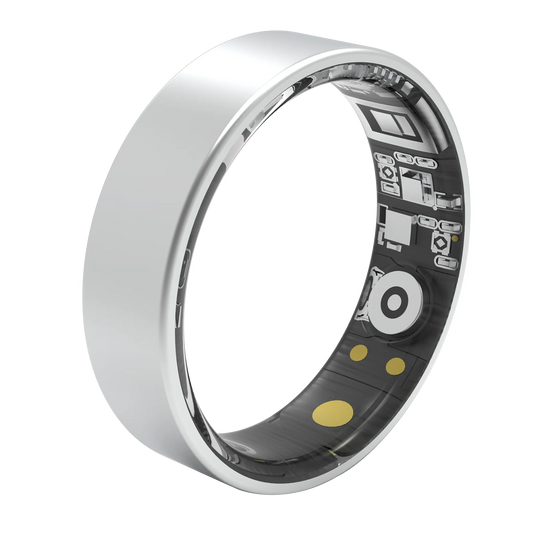
This is the ring's main contribution. Your ring uses photoplethysmography (PPG) — green, red, and infrared LEDs shining light into the finger and measuring how much bounces back with each pulse. From the pulse waveform it derives heart rate and, usually, heart rate variability.
Heart rate matters because, across a wide range of intensities, oxygen consumption rises roughly in step with heart rate. If the device knows your heart rate and your body size, it can estimate VO₂, and from VO₂ it can convert oxygen into calories. This is why heart rate data is the backbone of any energy expenditure wearable, and why our separate guide on smart ring heart rate accuracy is worth reading alongside this one.
Step 3: Motion tells the ring what you are doing
Heart rate alone is ambiguous. A heart rate of 120 could be a hard run, a stressful meeting, or three coffees. So the ring adds a 3-axis accelerometer to detect movement, cadence, and intensity, then matches the pattern to an activity intensity — often expressed as a MET (metabolic equivalent) value. The Compendium of Physical Activities is the research reference that assigns MET values to hundreds of specific activities, and most consumer algorithms are downstream relatives of it.
One honest limitation: rings do not usually carry GPS (it would destroy the battery). For outdoor workouts, distance and pace typically come from your paired phone, so a walk tracked with your phone in your pocket will produce better distance-based calorie math than one tracked with the phone on the desk.
Why the Finger Is Actually a Good Place to Measure
Skeptics ask whether a ring can compete with a chest strap or a wristwatch. The physiology says the finger has a real advantage.
The finger has a denser capillary bed and higher perfusion than the wrist, which produces a stronger PPG signal relative to noise. In a 2025 validation study of a research-grade smart ring against a clinical pulse oximeter, pulse rate tracked well in both static and dynamic conditions (r = 0.91), with a mean bias of just 0.26 bpm — see the smart ring pulse rate and SpO₂ validation study.
But there is a catch specific to rings: rotation. Because a ring is circular, it can spin around the finger and change the optical path through tissue, which degrades signal quality. That problem is real enough that researchers have designed rotation-robust PPG layouts for smart rings, reporting mean absolute errors of 0.78–0.82 bpm once the LED-to-sensor geometry was optimized.
Translated into everyday advice: fit and orientation matter more on a ring than on a watch. A loose ring that rotates is a noisy sensor — see our smart ring finger choice and size guide.
How Accurate Is a Calorie Tracker Ring, Really?
Here is where we stop marketing and start citing.
Heart rate is good. Calories are not. A widely cited 2017 Stanford study of seven wrist wearables found heart rate was within 5% of reference measurements for six of seven devices — but energy expenditure error ranged from 27% to 93% (Shcherbina et al., Journal of Personalized Medicine).
This is an industry-wide problem, not a ring problem. A 2020 systematic review in JMIR mHealth and uHealth covering 36 studies and 312 comparisons found that for energy expenditure, no brand was within ±3% of the criterion measure more than 13% of the time — while step counts and heart rate performed far better (Fuller et al., 2020).
The bias usually runs high, and it varies by body. A 2026 PLOS One study put four popular smartwatches against a COSMED K5 metabolic analyzer during controlled cycling. Typical errors ran 15–25%, with mean overestimates of about 22 kcal (Apple), 57 kcal (Samsung), and 69 kcal (Garmin). Critically, error grew as body fat percentage increased across all brands (Kostrna et al., PLOS One). The researchers' own advice: treat the displayed number as a ceiling, not a ledger.
We will be straight with you: we have not published a lab-validated calorie accuracy figure for Osawalla rings, and we will not invent one. Our rings use the same sensor class and estimation logic as the devices studied, and inherit the same category of error. Any brand quoting a precise accuracy percentage for consumer calorie tracking should be asked to show the validation data.
 Total Calories vs Activity Calories: Trust Different Numbers
This distinction solves most of the frustration.
· Total daily burn is dominated by resting metabolism, which comes from a stable equation and your profile. It is comparatively steady, so its trend is trustworthy.
· Activity calories are the volatile part. They depend on heart rate response, activity-type detection, and a proprietary algorithm — this is where the 15–25% (or worse) error concentrates.
So: watch your 7-day average of total burn. Discount any single workout's active calorie number, especially if you plan to eat it back.
Seven Ways to Make Smart Ring Calorie Data Actually Useful
1. Fix your profile, then maintain it. Correct height, sex, age, and current weight; re-enter weight roughly every four weeks, since a few kilograms of drift shifts your baseline.
2. Get the fit right. A snug ring that does not rotate produces cleaner PPG. If you are between sizes, use a smart ring sizer kit before you buy.
3. Use workout mode for anything structured. Rings struggle most with gripping, isometric effort, and intervals — hand tension and rapid heart rate swings both degrade finger PPG. Start sessions manually, or pair a GPS device for runs and rides.
4. Judge weeks, not days. A single day is noise; a rolling 7-day average is signal.
5. Round active calories down. If your ring says 500, budget for ~350–425. That is not pessimism; it matches the research.
6. Validate against the scale. Weigh daily, compare weekly averages over three weeks. If the scale is not moving but your ring claims a 500-calorie deficit, trust the scale.
7. Sync your data. Ring heart rate plus phone GPS beats either alone — see Apple Health & Strava sync: what to check.
Where Osawalla fits
Two options, both with no subscription fee — worth checking, because several competitors lock calorie and readiness data behind a monthly plan (why that matters).
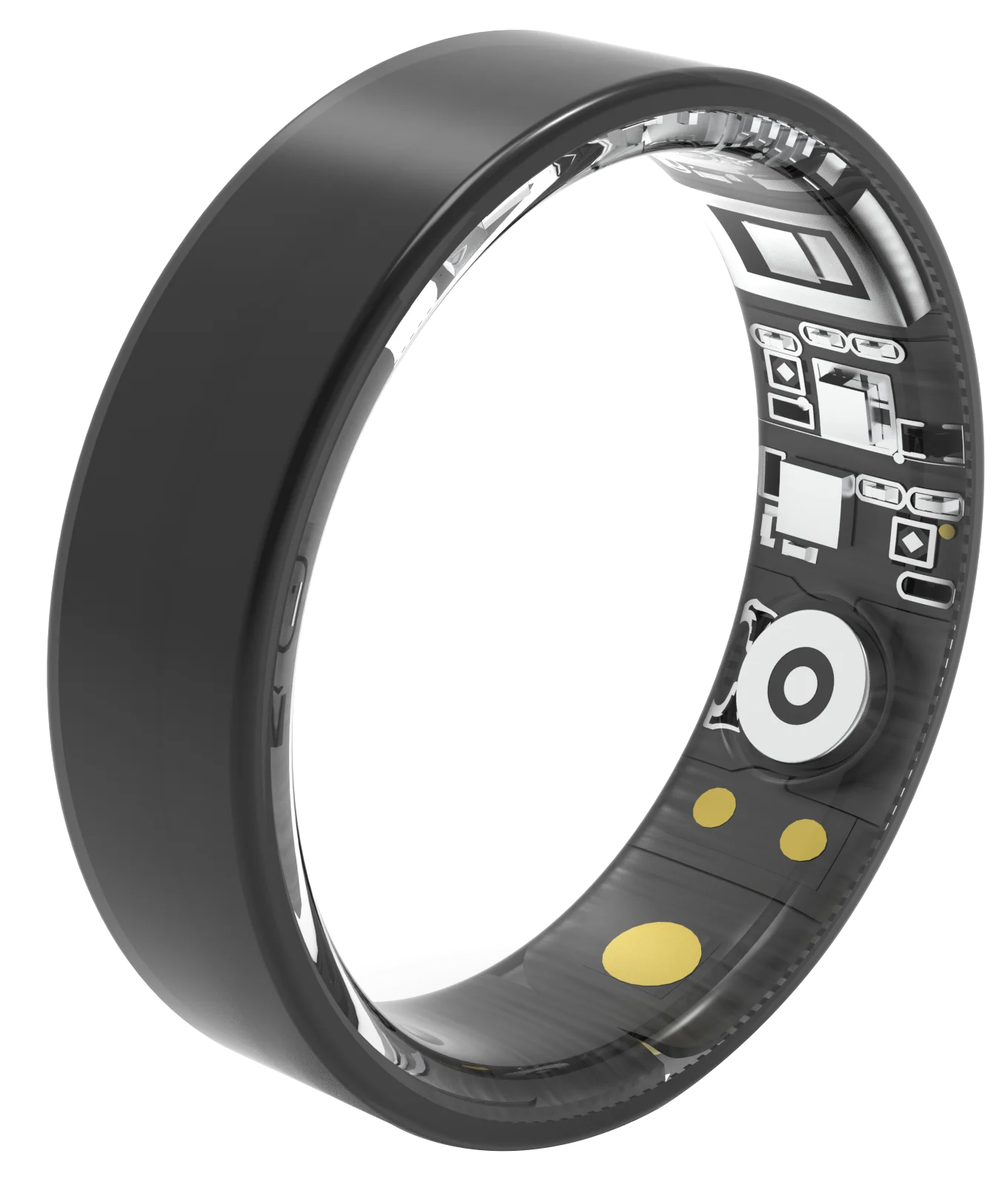
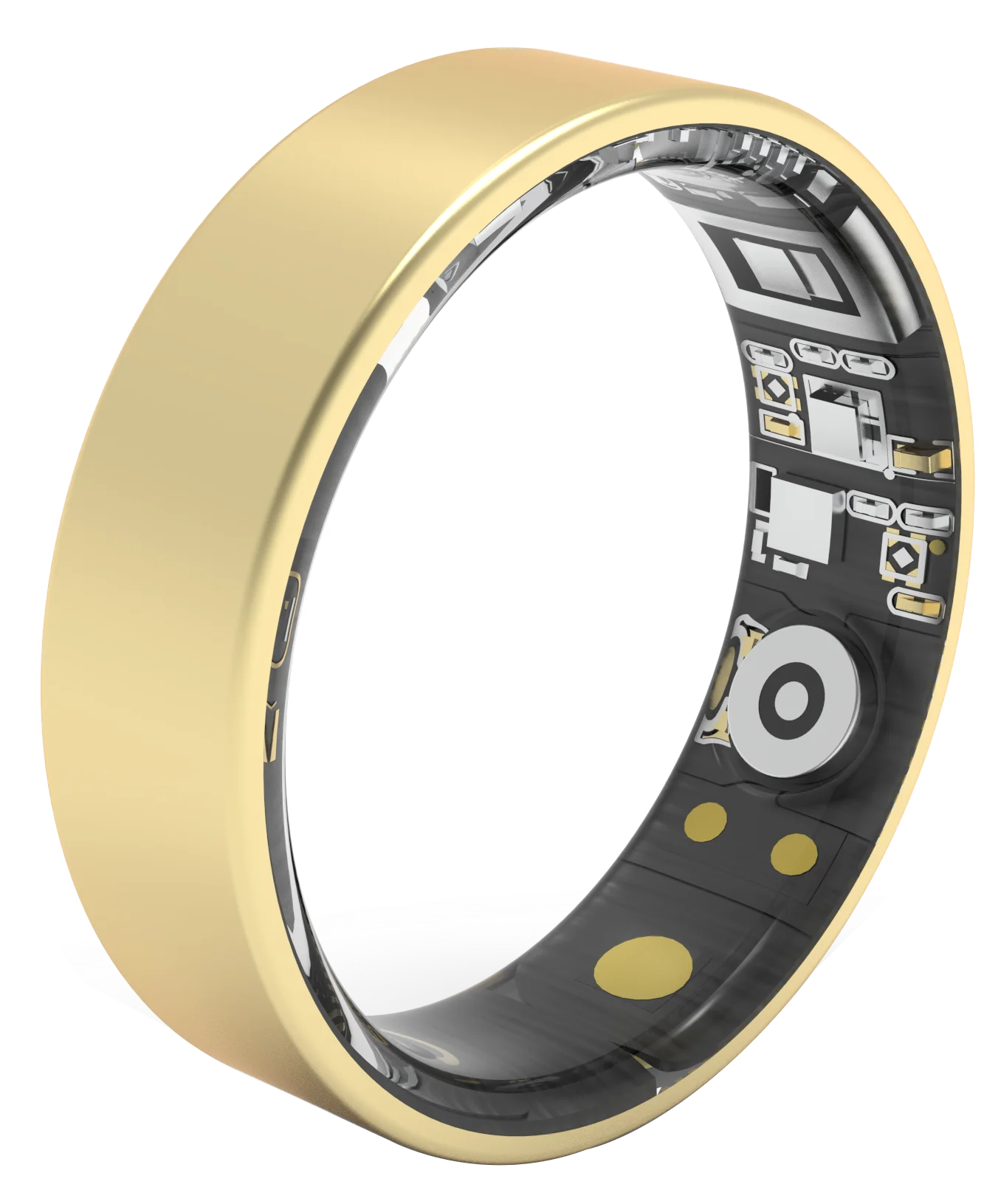
· Osawalla Signature Pro Smart Ring — 24/7 health monitoring, smart fitness tracking, advanced sleep tracking, and daily goals for steps, calories, and distance. Up to 5–7 days of battery.
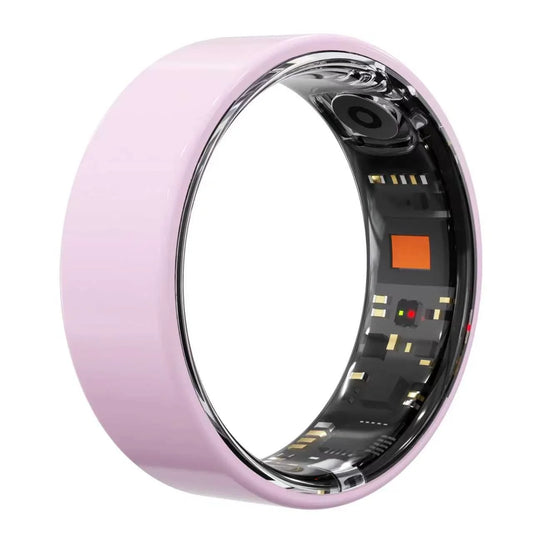
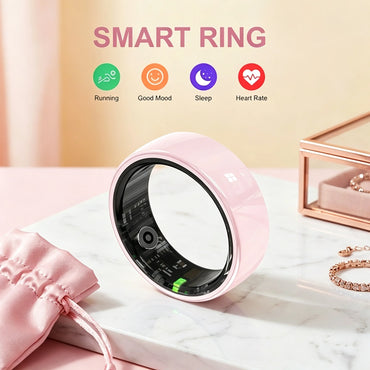
· Osawalla Ceramic Pro Smart Ring — 4 g ceramic build, 2.6 mm profile, sleep and HRV tracking, cycle and ovulation tracking, up to 7–9 days of battery, 5ATM/IP68 water resistance.
Both deliver continuous heart rate and activity data with no monthly bill. Browse the Osawalla smart ring collection to compare.
FAQ
Do smart rings track calories?
Yes. They estimate total daily burn and activity calories from your profile, continuous finger-PPG heart rate, and accelerometer motion. It is an estimate, not a direct measurement.
Are smart ring calories accurate?
Heart rate readings are generally good; calorie estimates carry meaningful error — studies of consumer wearables find typical errors of 15–25%. Use trends, not single readings.
Why does my ring show fewer calories than my watch?
Brands use different proprietary algorithms, and devices bias in opposite directions — some systematically overestimate, others underestimate. Wear position and profile inputs also matter. Neither device is automatically "right."
Does a smart ring count steps and distance?
Most count steps via the accelerometer. Outdoor distance usually comes from your phone's GPS, so carrying the phone improves accuracy.
Do I need a subscription to see calorie data?
It depends on the brand — some charge monthly for full metrics. Osawalla rings include the app experience with no subscription.
 The Bottom Line
Smart ring calorie tracking is a three-part estimate: a resting baseline from your profile, a heart rate signal from your finger, and a motion signal that labels the activity. The heart rate part is solid; the calorie conversion is where error lives — typically 15–25% for activity calories across the industry, and worse for short, intense, or grip-heavy sessions.
Used as a trend line, your daily burn is genuinely useful. Used as precise accounting, it will mislead you. Track the seven-day average, round active calories down, and let the scale be the final referee.
If you want the full picture of what a ring measures well, start with what a smart ring is, then read how a smart ring tracks sleep and how blood oxygen monitoring works.
Sources
8. Shcherbina A, et al. Accuracy in Wrist-Worn, Sensor-Based Measurements of Heart Rate and Energy Expenditure in a Diverse Cohort. J Pers Med. 2017.
9. Fuller D, et al. Reliability and Validity of Commercially Available Wearable Devices... Systematic Review. JMIR mHealth uHealth. 2020.
10. Kostrna J, et al. Body fat, skin tone, and the accuracy of smartwatch caloric expenditure estimates. PLOS One. 2026.
11. Frankenfield DC, et al. Comparison of predictive equations for resting metabolic rate... systematic review. J Am Diet Assoc. 2005.
12. An Adjustable Smart Ring to Monitor Pulse Rate and Peripheral Blood Oxygen Saturation. Ann Biomed Eng. 2025.
13. Development of a Rotation-Robust PPG Sensor for a Smart Ring. Sensors. 2025.
14. Compendium of Physical Activities — MET reference database.
General information only, not medical advice. Calorie needs vary with medication, medical conditions, and body composition — consult a clinician or registered dietitian before significant dietary changes.
Link List
· smart ring vs smartwatch — https://www.osawalla.com/blogs/news/smart-ring-vs-smartwatch-which-is-better-for-health-sleep-tracking-osawalla
· systematic review of RMR prediction equations — https://pubmed.ncbi.nlm.nih.gov/15883556/
· smart ring heart rate accuracy — https://www.osawalla.com/blogs/news/smart-ring-heart-rate-monitoring-how-accurate
· Compendium of Physical Activities — https://pacompendium.com/
· smart ring pulse rate and SpO₂ validation study — https://pmc.ncbi.nlm.nih.gov/articles/PMC12960368/
· rotation-robust PPG layouts for smart rings — https://pmc.ncbi.nlm.nih.gov/articles/PMC12567997/
· smart ring finger choice — https://www.osawalla.com/blogs/news/smart-ring-finger-choice
· size guide — https://www.osawalla.com/blogs/news/smart-ring-size-guide-how-to-find-the-right-fit
· Shcherbina et al., Journal of Personalized Medicine — https://pmc.ncbi.nlm.nih.gov/articles/PMC5491979/
· Fuller et al., 2020 — https://pmc.ncbi.nlm.nih.gov/articles/PMC7509623/
· Kostrna et al., PLOS One — https://journals.plos.org/plosone/article?id=10.1371/journal.pone.0353261
· smart ring sizer kit — https://www.osawalla.com/products/smart-ring-sizer-kit
· Apple Health & Strava sync: what to check — https://www.osawalla.com/blogs/news/smart-ring-apple-health-strava-sync-what-to-check-2026
· why that matters — https://www.osawalla.com/blogs/news/smart-ring-no-subscription-why-it-matters
· Osawalla Signature Pro Smart Ring — https://www.osawalla.com/products/osawalla-signature-pro-smart-ring
· Osawalla Ceramic Pro Smart Ring — https://www.osawalla.com/products/osawalla-ceramic-pro-smart-ring
· Osawalla smart ring collection — https://www.osawalla.com/collections/osawalla-smart-ring
· no subscription — https://www.osawalla.com/blogs/news/smart-ring-without-subscription-what-actually-matters-in-2026
· what a smart ring is — https://www.osawalla.com/blogs/news/what-is-a-smart-ring
· how a smart ring tracks sleep — https://www.osawalla.com/blogs/news/how-does-a-smart-ring-track-sleep-the-honest-science-backed-answer
· how blood oxygen monitoring works — https://www.osawalla.com/blogs/news/smart-ring-blood-oxygen-monitoring-spo-how-it-works


