Wearable Health · Stress & Mood
HRV Baseline: How to Build a Personal Reference
By the OSAWALLA editorial team · 2026-11-06 · 10 min read
By Osawalla Editorial Team
Published:November 7, 2026· Approximately 10-minute readMake your readings comparable before you make them meaningful.
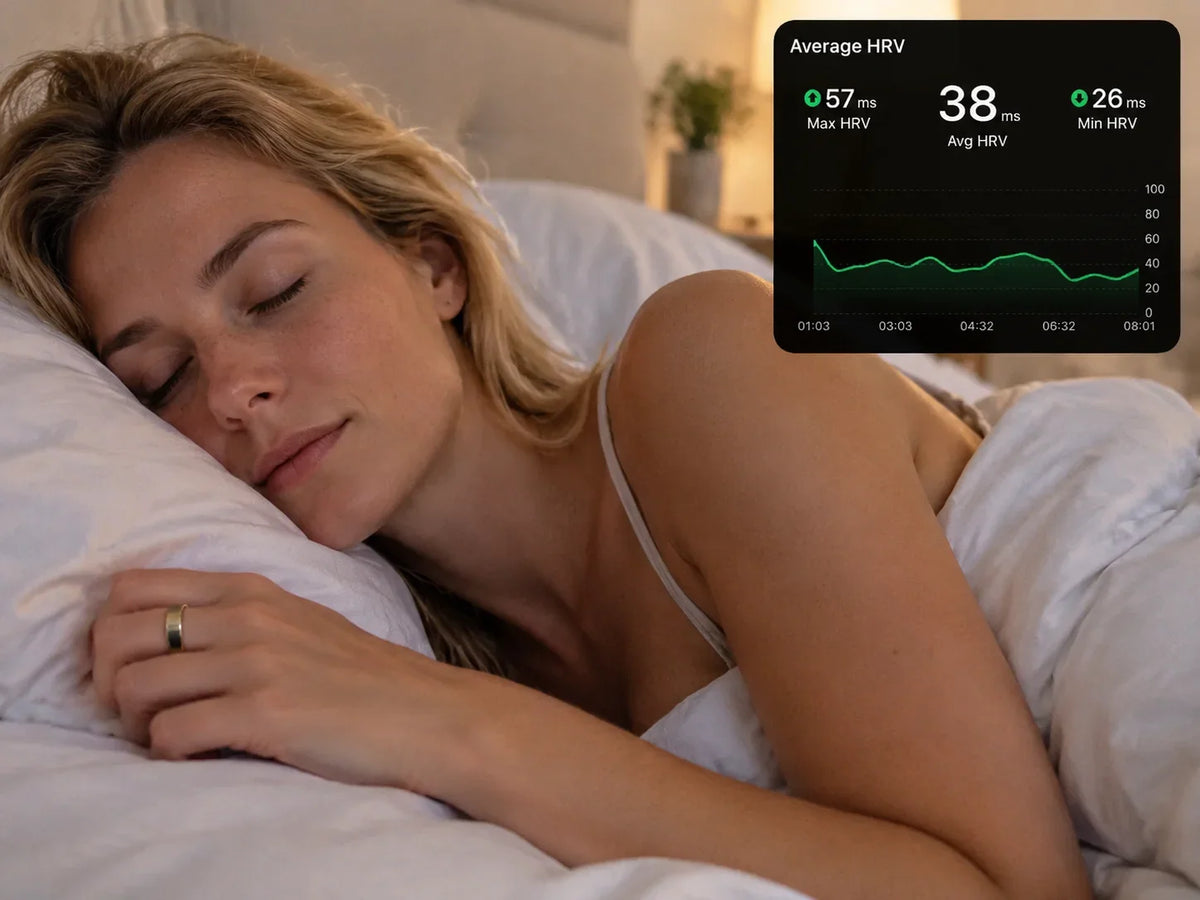
Your wearable shows 38 milliseconds this morning. Someone else's dashboard shows 72. Before you wonder whose number is “better,” ask a more useful question: were those numbers measured and calculated the same way?
An HRV baseline is a personal reference built from repeated, comparable readings. It helps you see how a new result relates to your own history. It is not a universal target, a diagnosis, or a score you need to beat.
The most useful baseline begins with a repeatable method: the same device, the same metric, and a consistent measurement window. This guide explains how to build that record, understand its limits, and choose a wearable that makes the process manageable.
1. Your Baseline Is a Reference, Not a Ranking
Heart rate describes how frequently your heart beats. Heart rate variability describes variation in the intervals between beats. Many HRV metrics use milliseconds, but that shared unit does not make them interchangeable.
RMSSD summarizes successive differences between normal beat intervals. SDNN describes the standard deviation of normal beat intervals over the recording. Recording duration matters, particularly when comparing short recordings with longer ones. A logarithmic value such as lnRMSSD is also a different representation from raw RMSSD in milliseconds. Shaffer and Ginsberg's review explains these metrics and their interpretation.
Before collecting a baseline, identify the metric your app displays. If the documentation only says “HRV,” ask the manufacturer what calculation and time window it uses.
“Usual for me” does not mean “medically healthy”
A baseline describes your recorded history. It cannot establish that your heart is healthy or identify the cause of a change. Current methodological guidance warns against treating HRV as a simple measure of sympathetic activity or a single balance between branches of the nervous system. See the cardiovascular HRV research guidelines.
Use the baseline to frame a question—“Is this different from my usual pattern?”—rather than to produce a medical verdict.

2. Choose One Sampling Method and Keep It Consistent
An overnight HRV baseline and a morning resting baseline are different records. Both can be useful, but they should not be combined into one series as though the sampling conditions were identical.
| Sampling approach | Keep consistent | Check the limitation |
|---|---|---|
| Overnight recording | Device, fit, measurement mode and the same nightly summary field. | Ask whether the value summarizes the full sleep period, selected segments or a particular sleep stage. |
| Morning resting check | Timing relative to waking, posture, settling period, recording length and breathing instructions. | Do not treat a short spot check as equivalent to an overnight summary. |
| Daytime spot check | Time, posture and recent activity as far as practical. | A reading after a meeting or workout has a different context from quiet morning rest. |
If you choose morning measurements
Follow the device's validated procedure. For a research-informed resting approach, Laborde and colleagues recommend consistent conditions, a settling period in the chosen posture, minimal movement, no talking and spontaneous breathing. Five-minute recordings are a conventional short-term research format; shorter measurements need validation for the specific metric and method. Source: Laborde, Mosley and Thayer, 2017.
Write your routine down: for example, after waking, before coffee or exercise, seated in the same place, using the same app procedure. Do not alternate ordinary breathing with a paced-breathing exercise and label the results equivalent.
If you choose overnight measurements
Wear the device according to its fit guidance and use the same displayed field each morning. A nightly average, nightly maximum and readiness score answer different questions.
Brand algorithms also differ. Garmin describes approximately three weeks of consistent overnight wear to establish its initial HRV baseline. Oura describes HRV Balance as a comparison of a recent 14-day average with a three-month average, weighting recent days more heavily. These are product-specific methods, not universal HRV rules. Garmin documentation; Oura documentation.
3. A Practical Four-Week Recording Plan
The following is an organizational example for building a useful diary, not a validated medical protocol or a replacement for your device's calibration requirements. Four weeks gives you a manageable first review point; it does not guarantee that every device has established its baseline.
Week 1: Make a measurement record
Write down your device model, app, HRV metric, units, sampling method and summary field. Add the firmware or app version if available. This small record helps explain later changes that might otherwise look physiological.
Focus on getting usable readings and a comfortable fit. Resist judging your baseline after the first few values. You are learning how the measurement process behaves.
Weeks 2–3: Collect ordinary life, not a perfect week
Continue the same routine. Keep a short note when something changes: travel, a late meal, alcohol, unusually demanding exercise, disrupted sleep, illness or medication changes. These notes record context; they do not prove why a value moved.
Do not delete a valid low reading just because you dislike it. If the signal was poor or the device was not worn, label the reading as missing or unreliable. Never enter zero to stand in for missing HRV.
| Entry | Measurement record | Context note |
|---|---|---|
| Night A | Same device and nightly field; record value and units. | Usual routine; slept at home. |
| Night B | Same field; retain a valid reading even if lower. | Late arrival after travel. |
| Night C | Missing: device was charging. | Do not substitute zero or copy the previous night. |
Week 4: Review the pattern and the coverage
Check how many comparable readings you actually collected. Twenty-eight calendar days with many gaps is not the same record as twenty-eight usable nights.
If your app supplies a baseline range, use its explanation of that range. If you keep a separate diary, a median of comparable readings can be a simple descriptive center. It does not reproduce a proprietary baseline algorithm or define a healthy range.
Keep the original readings alongside any summary. If you add a seven-day average, label the window and number of available readings. Use the same calculation over time rather than switching methods when the result feels disappointing.
4. Read Your Personal HRV Trend Without Overinterpreting It
A personal HRV trend becomes easier to interpret when you separate three questions: was the measurement usable, were the circumstances comparable, and has the change persisted?
Consider a hypothetical diary. Your usual readings sit near one another, then several nights shift after a trip. That is a reason to review sleep timing, travel notes and recording quality. It is not proof that travel caused the shift, and it does not identify a condition.
The sensor and algorithm are part of the result
ECG detects electrical heart activity. Optical wearables use photoplethysmography, or PPG, to detect peripheral pulse signals. Variability derived from those pulses is technically pulse rate variability; it should not be assumed identical to ECG-derived HRV in every condition. This methodological review examines that relationship.
Signal filtering, artifact handling and averaging also matter. A 2022 study comparing Oura with ECG analyzed 35 healthy participants and found that accuracy differed by metric and aggregation window. Nightly averages generally had lower error variance than five-minute segments. The authors emphasized limits on generalizing beyond overnight recordings and healthy participants. Read the validation study.
That study does not validate every ring, every firmware version, or any Osawalla product. A buyer should look for evidence matching the exact device, metric and intended conditions.
Treat equipment changes as a break in the record
If you change devices, measurement timing or algorithms, mark the date. Keep the resulting series distinguishable. Do not interpret a sudden difference between two brands as a sudden change in your body.
A software update does not necessarily alter HRV, but noting it makes an unexplained shift easier to investigate. Ask whether the update changed processing before attempting to compare the periods directly.
Let symptoms take priority
Neither a high value nor an app's “balanced” label rules out illness. Do not change medication or make major training decisions from HRV alone. Discuss persistent unexplained changes or concerns with a qualified clinician.
If palpitations occur with chest pain, shortness of breath or fainting, seek urgent medical help rather than waiting for a wearable trend to confirm a problem. NHS guidance describes these warning symptoms.
5. Choose a Wearable That Supports a Repeatable Record
When shopping for HRV tracking, prioritize the measurement experience over promises to “optimize” your score. The useful purchase is a device you can wear consistently and understand afterward.
- Named metric: does the documentation identify RMSSD, SDNN or another calculation?
- Clear timing: does it record overnight, during spot checks, or both?
- Visible history: can you review past values, gaps and trends rather than only a daily score?
- Practical wear: is the fit comfortable enough for your intended overnight routine?
- Transparent access: which graphs, exports or interpretations require a subscription?
- Relevant evidence: is validation available for the model and conditions you care about?
Preview the app before you buy
Ask to see an example history screen, not just a promotional image with a large HRV number. Can you identify the date, units, missing nights and measurement type? Can you look back far enough to understand your routine, or does the interface emphasize only today's result?
Also consider how you would keep context. An app with notes can be convenient, but a separate private diary may be sufficient. Check what an export contains before assuming it includes raw beat intervals; a list of nightly summaries is a different dataset.
Finally, review the account and privacy controls for your health information. A clear explanation of collection, access and deletion helps you decide whether the tracking arrangement fits your preferences alongside its measurement features.
“Which HRV metric does this model display, when is it sampled, how is the nightly value calculated, and can I see my history without relying only on a readiness score?”
Ask those questions while exploring Osawalla smart rings or fitness trackers. Confirm HRV availability and the exact method for the model you choose; a category name or a heart-rate feature does not establish HRV capability.
6. Questions About Building an HRV Baseline
How long does an HRV baseline take?
There is no single setup period for every device. Follow the manufacturer's requirement, then keep collecting comparable data. The four-week diary here is a practical review schedule, not a universal calibration standard.
What is a good HRV baseline number?
No single number is a suitable target for everyone. Metric, recording duration, age and measurement conditions complicate comparisons. Start with your own consistent record rather than a friend's screenshot.
Can I mix morning and overnight readings?
Keep them as separate series. They represent different sampling conditions, even when both are labeled RMSSD. Consistent labels alone do not make the measurement windows equivalent.
Should I restart after one low reading?
Not automatically. Check quality and context, retain valid data, and follow the app's instructions. Repeatedly restarting can remove the history you need to understand ordinary variation.
Is higher HRV always better?
No. Unexpected increases also need context, and recording artifacts or irregular beats can complicate interpretation. The aim is a trustworthy personal reference, not the highest number you can produce.
This article is general information, not medical advice. OSAWALLA devices are wellness products and are not intended to diagnose, treat, cure or prevent any disease. Speak to a clinician about any health concern.